Pace
Know exactly how long your culling and editing really take. Time each phase, learn your true speed, and finally give couples a turnaround date that isn't a hopeful guess.
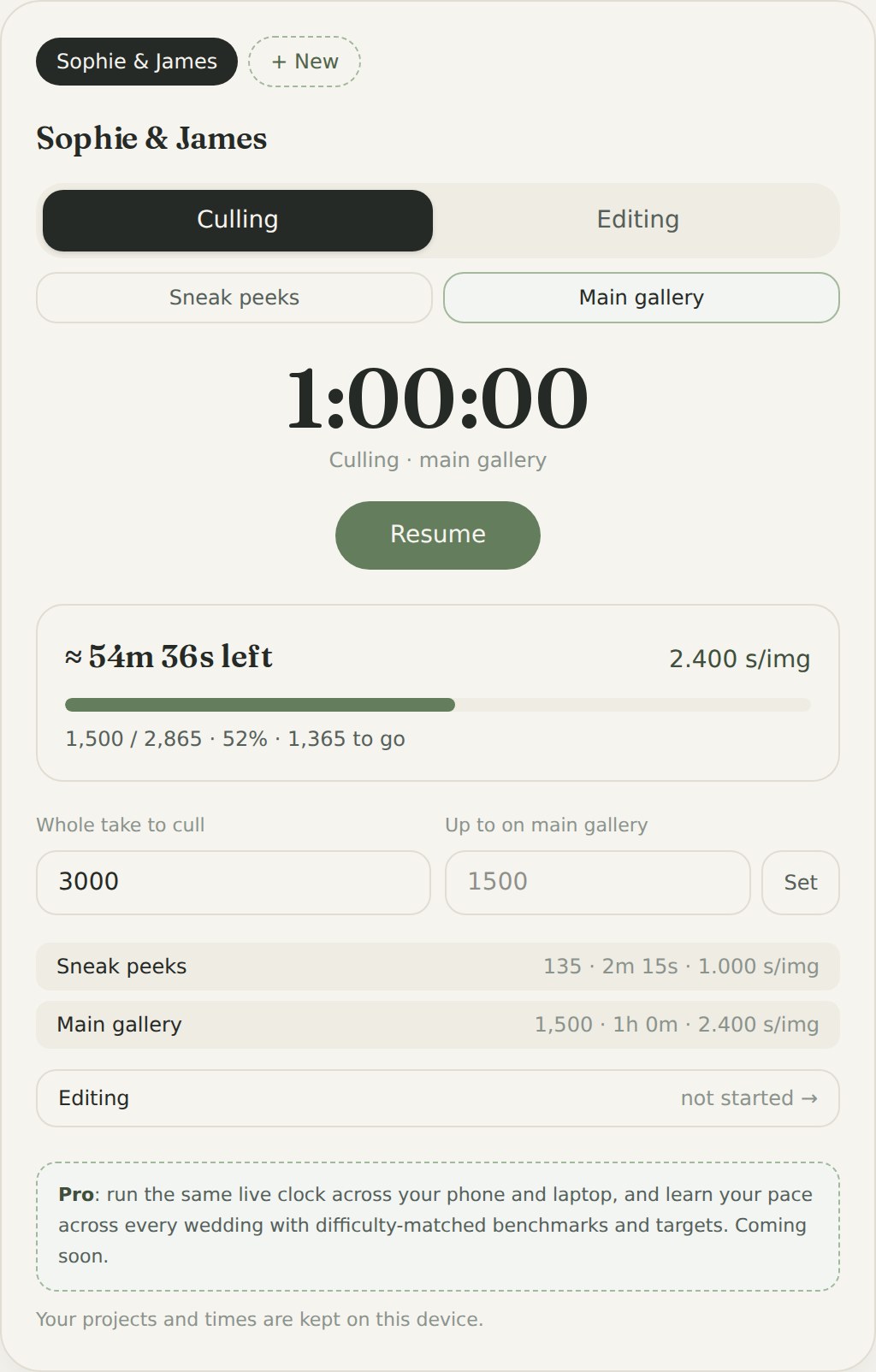 Open the tracker
The real, free tracker opens on its own page, and it saves beautifully to your home screen.
What it does
Turn a guess into a number.
Time culling and editing
A calm stopwatch for each phase, with Start, Pause, Resume and Stop. Sneak peeks and the main gallery are timed separately, because they run at a different pace.
Your true seconds-per-image
Log where you're up to and it works out your real pace, to three decimals, because culling is fast and whole seconds hide the differences that matter.
A live finish line
Once it knows your pace and your gallery size, it shows a time-left estimate and a progress bar. The open-ended slog gets an end you can see.
Faster or slower?
Every time you pause and log your position, it tells you how that sitting compared to your average so far on this wedding. Quietly motivating.
How it works
Six small steps, one clear number.
No setup, no learning curve. Start the clock when you sit down, and log where you got to when you stop. The tool does the maths.
- 1
Add the couple
Start a job with their names. Cull and edit are tracked separately, and everything is kept on your device.
- 2
Pick a phase and stage
Culling or editing, then sneak peeks or the main gallery. The timer and counts attribute to whichever you're on.
- 3
Run the clock
Start when you sit down, pause when you stop. Each stretch is one sitting.
- 4
Log where you're up to
On a pause, tap in your running total (say, culled up to 1500). It works out how many that sitting produced.
- 5
See how you did
A small note tells you your pace for that sitting and whether it beat your average so far on this project.
- 6
Watch the ETA fall
Add your gallery size and the progress bar and time-left estimate do the rest, all the way to done.
Behind the build
A few things I thought about.
- It came straight out of my own CRM. I built it because I was tired of promising couples a turnaround date that was really just a hopeful guess.
- Position is the source of truth. You always tap in a running total (I'm up to 1500), never a per-sitting count, so the maths can never double-count. It's the one thing people find fiddly, so the tool is careful to label it clearly.
- Sneak peeks are timed apart from the main gallery on purpose. A twelve-image sneak set runs at a very different pace to a nine-hundred-image edit, and mixing them would give you a meaningless average.
- Seconds-per-image is shown to three decimals. It looks fussy until you realise culling runs at a couple of seconds an image, and that's exactly where the useful differences hide.
- Like the other tools, the life-shaping bits (syncing across your devices, and learning your pace across every wedding you shoot) are what a paid Pro is for. The free tracker is genuinely useful on one device, on its own.
Where it could go
Ideas for a Pro version.
The free tracker is genuinely useful on its own. Here's where a paid Pro could take it. Your feedback shapes what gets built.
Sync everywhere (Pro)
The same live clock on your phone and your laptop, with every wedding you've tracked saved safely off your device. Start culling at the desk, glance at the ETA from the sofa. This is the piece that needs a light login.
Learn your pace across weddings (Pro)
Averages by phase and by an easy / medium / hard difficulty, so a new job arrives with a genuine estimate from day one, not a hopeful guess.
Honest turnaround dates (Pro)
Turn your learned pace and a gallery size into a delivery date you can actually promise a couple, with a gentle 'on track' or 'slipping' read as you go.
Targets to beat (Pro)
Set yourself a pace to aim for and let the tool cheer you towards it, instead of only ever comparing against your own past.
Plan your capacity (Pro)
At your real pace, see how many more weddings you can take this season and still deliver on time. Booking decisions grounded in fact, not optimism.
A weekly edit budget (Pro)
Decide how many post-shoot hours you'll spend a week, and let Pace help protect them. Pricing for a life, made literal.
Would this earn a place in your workflow?
Tell me how you cull and edit, what would make this genuinely useful, and what you'd want from a Pro version. It shapes what I build next.